
The New Computer
Perplexity, Lovable, ElevenLabs and the battle to own the next generation of AI
David Hockney
One of my heroes died this week. I wanted to pay tribute to him because:
he was a relentless innovator – from Polaroids to joiner photographs to iPad drawings;
as a consequence he constantly reinvented himself – relocating from London to LA to Yorkshire to Normandy, drawing new inspiration in each location;
he loved his work and carried on producing great art, likely to his last days;
and he was his own man – from his chain smoking to his eccentric dress, notably wearing yellow Crocs to Buckingham Palace.
I was lucky to be invited to the private view of A Bigger Picture at the Royal Academy in 2012. Hockney had a real presence, even among a star-studded guest list. I missed his recent Paris exhibition but have been to countless others, even taking my young boys to a show at the Tate. The current Serpentine Gallery show features a series of iPad drawings of his garden at Normandy through four seasons.


London Tech Week Exhibitors
London Tech Week attracted 30,000 attendees from 130 countries and brought together many of the most important founders, investors and AI companies in the world. After spending three days there, I came away with one overwhelming conclusion: almost everyone building AI believes we are still early in its development.
(I previously visited Italian Tech Week - I wrote about it here on Jeff Bezos, here and here).
There was a large exhibition area and multiple stages with speakers, panels and fireside chats with a wide range of VCs, founders, politicians and more. Vendors exhibiting included the big names like AWS and nScale and lots of tiny startups. What caught my eye though was the number of country stands – there was a UK/GB stand, a Scotland stand (anticipating independence?) and a London stand (London & Partners is a growth agency funded by the local authority).

I spotted Cyprus, Tunisia, Pakistan, Turkey (huge stand, bigger than AWS), Poland, The Ruhr in Germany, Malta, Costa Rica, Portugal (plus a Portugese region I forgot to write down), Estonia, Romania, S Africa, The Philippines, Spain, Uzbekistan, Indonesia and I swear I saw Kyrgyzstan, a country I could neither spell nor find on a map, but I couldn’t find it a second time.
I asked organiser Informa why all the country stands, but they didn’t know (££££). Most of these stands included a number of local startups and some told me that they were there because their Government paid and they wanted to come to London, and hopefully some business might come from it.
There were quite a few interesting exhibitors and I used this opportunity to speak to some of the sales people and better understand the eco-system. Lead Forensics uses IP addresses to identify which companies have visited your website – I may try that for a couple of months. I hadn’t seen Plaud before – they make devices which record your conversations.
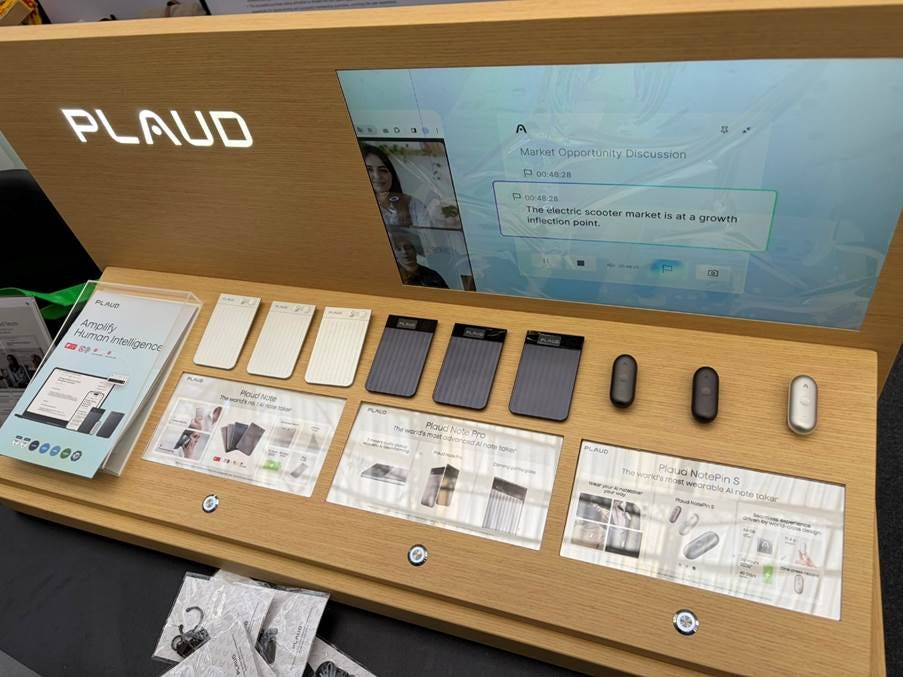
The flat devices in the picture are really small and can hold 50 hours of content and they are about £150. I may try this as it would be quite useful for conferences – I can check the transcripts later if I had missed something. You can use your phone of course but I think this might be easier, as it can be on all the time even when you are using your phone – has anyone tried Plaud?
I met a couple of vendors which produce systems where you can upload your documents and then interrogate them using an LLM. I could use Notebook LM but when I have a major project, I find it cannot cope with the volume. These claimed that I would be able to upload my 300 newsletters and then interrogate them safely and easily. One was Elastic and the other was LlamaIndex – apparently there are lots of alternatives. Ideas from readers welcome.
Loc.ai provides infrastructure to run AI models locally on your own device, so you can scale AI apps without relying solely on the cloud. It offers an OpenAI‑compatible API and a control plane to orchestrate which workloads run on-device versus on-prem or in your own cloud. I thought that was quite interesting, as many people are now complaining about the soaring costs of token usage.
Before getting to the presentations, a word from this week’s sponsor:
The real alpha lies in AI bottlenecks.
Most investors are late to the Mag-7 party. While these companies continue to get all the attention, Market Sentiment focuses on identifying the second-order effects early.
They were the first to cover the Optics Trade, with the basket now up 90%. Their Advanced Packaging Thesis is also now playing out in real time, with the portfolio up 87% in four months. They predicted the AI energy bottleneck last year.
They just launched the Agentic Basket, which covers the second-order winners of the agent buildout. For the next 24 hours, Behind The Balance Sheet readers can now unlock full access to Market Sentiment at a special discounted rate.
Presentations
There were way too many presentations to attend all of them so I opted for what I thought might be interesting to you or to my business.
Sir Keir Starmer
Prime Minister Sir Keir Starmer opened the event with a flat presentation. I hadn’t seen him speak live before and he was perhaps understandably far from energetic. One of his team had to burst into loud applause, cueing the audience when he highlighted achievements – the UK is the third largest tech economy in the world, UK startups raised half of all money in Europe this year, and Reflection AI creating 1000 UK jobs over the next 3 years.
Government is trying to remove red tape, improve access to the best talent, and to facilitate access to capital, particularly scale up capital where we have a real shortage. And on AI, it’s trying to promote UK companies, support British companies with its own infrastructure spending and offer a sensible regulatory framework. He also highlighted the protection of children from social media and the transmission of lewd images.
Government is rolling out AI tutors, initially to 450,000 kids on free school meals. I am all for supporting kids from poorer families who may be just as talented but are disadvantaged, but this sounds like a great initiative, albeit with a typically short-sighted application. If it’s good enough, give it to everyone.
The good news, and it was a recurring theme, is that the UK is a real player in AI, unlike previous tech waves. DeepMind is headquartered here and several companies highlighted the UK’s depth of talent, top universities and research quality.
Lisa SU, AMD
The Chair and CEO of AMD was in London to announce a £2bn investment in the UK over the next 5 years. She highlighted a vibrant eco-system and research partnerships with Cambridge and Imperial. She explained that it’s very early in the development of AI, so it’s hard to predict outcomes. They are using AI extensively internally for development and are investing in a number of UK startups. Success to her is using AI to solve some of the world’s most difficult problems, especially in healthcare. My takeaway was her highlighting how early we are in AI’s development, a recurring theme.
Darren Hardman, Microsoft
The CEO of Microsoft UK and Ireland gave a speech on how Microsoft was helping its clients. The slides were fantastic, the content not so much. Microsoft have committed £30bn investment in the UK to build the AI economy. It’s moving information work to intelligence work.
He highlighted how HSBC had reduced customer response times by one-third using AI; how the NHS was rolling out CoPilot to half a million workers after a trial suggested an average benefit of half an hour per day; how retailers like Marks and Spencer and Sainsbury were finding benefits on the shop floor; and how universities were making CoPilot available to all staff and students (65k at Manchester). Microsoft are launching an AI Skills Festival here and an AI Skills Centre of Excellence at Durham University.
Microsoft’s advantage today is trust rather than functionality. The question for investors is whether that remains true once AI applications mature and become blue-chip vendors in their own right.
Aravind Srinval, Perplexity
The Co-Founder and CEO of Perplexity gave a talk entitled The New Computer. He sees AI as amplifying human intelligence. In the past, the search agent was just the start of a journey – Google and peers gave you the links which you then had to investigate. Google turned a paper and card library into a $300bn advertising business.
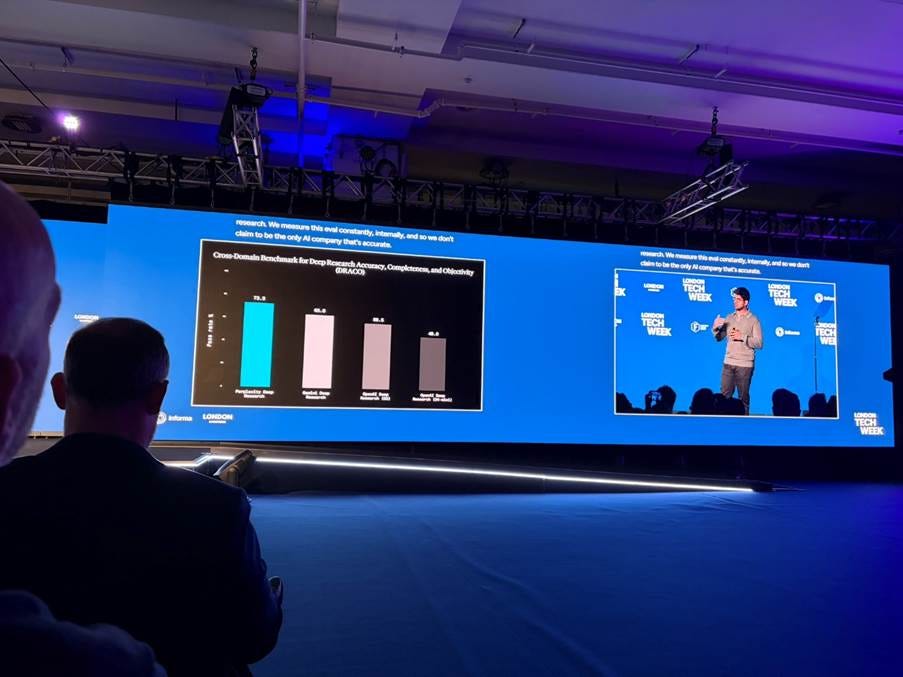
Perplexity is 100% focused on accuracy. Search is a foundation, which opens up dozens of other technologies. Steve Jobs famously said that the computer is a bicycle for the mind and now “Computer is a Ferrari for the mind with AI as the engine”. With AI we move from processing information to reasoning, transferring raw information into decision and inference.
AI moves a computer from a machine that works from instructions to one that works towards objectives. And Perplexity Computer is an AI operating system which creates teams of agents which it then orchestrates like a conductor in an orchestra. Perplexity Computer takes 15 different models to generate these agents.
A couple of videos showed Perplexity Computer at work, generating a research report from Nvidia’s earnings and producing a TikTok reel from a YouTube podcast. I have tried to use it, but with no success so far.
AI is changing the definition of what a computer is. Perplexity Computer needs your personal context, your files, and how you do your work to be most effective – which means you no longer need to be in front of your PC screen. Interestingly, they are now using a hybrid agentic interface which means you can run a local model on your PC for sensitive data - the data centre is moving to your device. Tasks can be delegated to whichever model you prefer, Claude’s Opus 4.8 or ChatGPT etc.
He highlighted that the models will become far more powerful. They ran a competition called the Billion Dollar Build – can someone come up with an idea which will be the core of a $1bn one-man startup? 1500 people registered and he was to announce the winner the next day with Sir Lewis Hamilton (I think they may be friends? He seems to like Ferrari). And he announced the Billion Pound Build Competition – using Perplexity Computer to build a company which can get to a £1bn valuation with a prize of £1m of token credits.
Of course he was impressive. And that they have chosen a route which embraces competing models is interesting – it suggests that they may see a future in which different models excel at different tasks. Which would mean several competitors in a commodity market which is my central case.
Alison Kaye, AWS
She talked of unlocking £35bn in productivity gains; of investing £8bn in UK data centers; and of achieving extraordinary efficiencies in coding – they rebuilt their inference engine Bedrock with 6 developers in 76 days using their Kiro AI; in the past that would have taken 40 developers 365 days – that’s a 32x improvement.
She talked about reimagining business processes. She said that the Department of Work and Pensions (DWP) has achieved a 68% productivity increase. The department receives 25k letters per day and it took 5 weeks to process a letter. Now they are using AI to categorise and process them.
LSEG is building an advanced information processing system. Capita serves 1.6m UK residents with AI chatbots. Amazon has 12bn AI-powered customer conversations pa.
This all sounds great. Meanwhile, Civil Service World says that DWP’s headcount was 96,890 in 2025, up 3.3% from 93,815 in 2024.
She talked about skills shortages and the need to invest in human capital. AWS has a programme to give 100k workers AI skills by 2030. And there are 5 decisions you can no longer defer:
Ethics and responsible AI
Costs
Security and governance
Workforce and skills
Business model changes – what new products or services are possible now?
I understand that these big companies don’t want to be controversial but this was an uninspiring talk.
So far, the message from London Tech Week has been remarkably consistent: AI adoption remains in its infancy, the UK is emerging as a serious AI hub, and the biggest opportunities may lie well beyond today’s headline winners.
Summary
Behind the paywall, I cover one of the fastest-growing software companies in history, an AI company that can clone your voice and detect emotions in real time, the views of investors from Andreessen Horowitz, Tencent and Khosla Ventures on where value will accrue in AI, and a fascinating discussion on why power, memory and data-centre infrastructure may become the industry’s next major bottlenecks.
I also share the most useful lessons from founders building AI businesses at scale, including one simple framework for navigating difficult periods that applies equally well to investing.